
By AI Landscape Design Team · Editorial policy
Drip irrigation vs Sprinkler irrigation: Which Fits Your Yard?
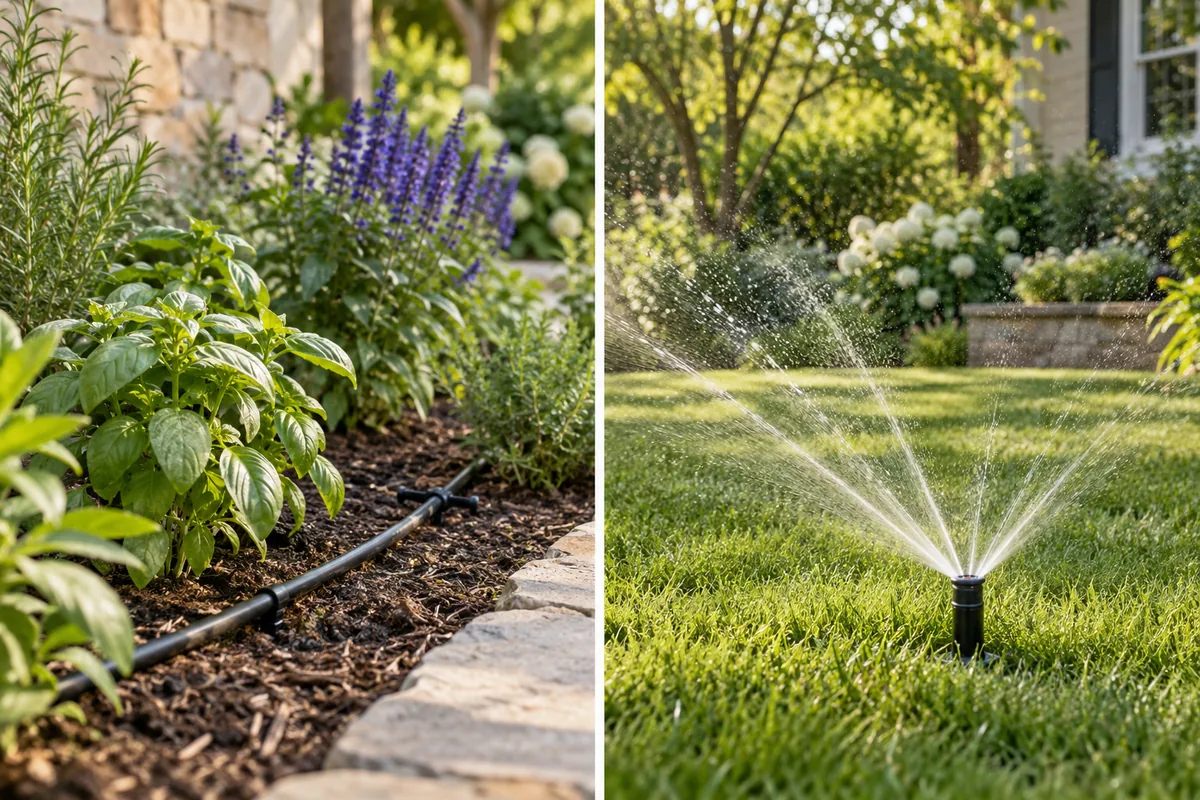
Choose drip irrigation for planting zones where localized delivery can suit the plants and layout; choose sprinklers where broad coverage of an appropriate area is needed. Many gardens use separate systems for different zones. Efficiency depends on design, installation, scheduling, weather, and maintenance, so neither label guarantees low water use. Match the method to the actual planting rather than replacing equipment without reviewing the site.
Published · 6 min read
Key takeaways
- Relative cost: Lower to Higher; Moderate to Higher.
- Maintenance: Inspect delivery points lines and filters; Inspect heads coverage and overspray.
- Lifespan factors: Product conditions maintenance and adaptation; Product conditions maintenance and exposure.
| Dimension | Drip irrigation | Sprinkler irrigation |
|---|---|---|
| Relative cost | Lower to Higher | Moderate to Higher |
| Maintenance | Inspect delivery points lines and filters | Inspect heads coverage and overspray |
| Lifespan factors | Product conditions maintenance and adaptation | Product conditions maintenance and exposure |
| DIY difficulty | Moderate to Higher depending on system | Higher for complex layout or supply work |
| Best for | Suitable localized planting zones | Appropriate broad-area coverage |
| Efficiency | Depends on matched design and scheduling | Depends on matched design and scheduling |
| Mixed systems | Review separate suitable zones | Review separate suitable zones |
Which plants and areas are being watered?
Separate the garden into areas with different verified needs before discussing equipment. A lawn, a mixed border, and a container collection may require different delivery arrangements and care. Drip can target selected planting positions; sprinklers can cover a broader area when that is appropriate to the planting and use. The distinction does not mean every bed suits the same emitter or every lawn suits an unchanged spray layout. Record plant distribution, soil conditions, exposure, and existing equipment. Check USDA hardiness zone and local plant suitability independently of irrigation choice. Water delivery cannot make an unsuitable plant or poorly understood soil condition appropriate simply by adding more control.
What can be said about water efficiency?
According to EPA WaterSense, microirrigation can reduce water use compared with conventional sprinkler systems in suitable applications. That is a reason to investigate it, not a guarantee for every installation. Water savings depend on replacing an appropriate use, delivering water correctly, and adjusting care to actual needs. A leaking drip line or a poorly scheduled system can still waste water. Sprinklers also benefit from suitable design and inspection. Avoid transferring a general percentage into a prediction for the property without a qualified assessment. Ask where current waste occurs, such as watering paving or delivering water to zones whose plants need less, then compare solutions to those specific problems.
How does placement influence performance?
Drip delivery points need to relate to the actual plants, rooting area, soil, and growth over time. A line placed for young planting may require review as plants change. Sprinklers need appropriate coverage without unnecessary overspray, and nearby obstacles or mismatched equipment can affect the arrangement. Have a qualified irrigation professional assess complex systems rather than copying a diagram from a different yard. The visual position of foliage does not reveal where water should be delivered. Keep maintenance access and avoid hiding components where they cannot be inspected. A useful design should explain the relationship between planting zones and water distribution, not merely display a tidy set of tubes or spray heads.
What should scheduling take into account?
Rainfall, season, soil moisture, plant needs, and establishment can change the appropriate practice. Do not offer one universal number of minutes or days for either method. Ask how the system will respond to actual conditions and who will review it after installation. Controls can support efficiency when compatible and properly used, but they do not remove the need to inspect the site. A separate zone beneath an overhang may receive different natural water from an exposed border. Grouping unlike conditions on one schedule can undermine either delivery method. The household should know how to recognize a problem and when to seek local professional adjustment.
Which maintenance tasks are easier to miss?
Drip systems can require attention to leaks, blocked or displaced delivery points, filters, and changing plant relationships according to the selected system's guidance. Sprinklers require inspection for damaged heads, poor coverage, and water reaching surfaces where it is not needed. According to EPA WaterSense, walking through irrigation zones and checking for waste is part of useful system care. Avoid calling a hidden drip layout maintenance-free because it is less visible during operation. Ask for instructions specific to the installation and retain product information. Keep access to controls and service points so equipment does not become uninspectable as the garden grows around it.
How should installation and costs be compared?
Existing equipment, water supply conditions, zones, controls, preparation, and labor affect the cost of a change. A drip conversion for an appropriate border is different from a full-site redesign. A sprinkler replacement can also involve more than swapping a head. Obtain proposals for the actual scope and ask what assessment and adjustment are included. The table uses broad relative categories rather than monetary estimates. Consider future changes to planting as well as immediate equipment price. An inexpensive arrangement that cannot be serviced or matched to the planting is not an equivalent alternative to a properly designed system. Confirm relevant local plumbing, backflow, and installation requirements with qualified professionals.
Can drip and sprinklers share a garden?
Yes, when separate appropriate zones and system requirements are addressed by the responsible professional. A usable lawn may be treated differently from planted borders, with each method selected for its role. Do not combine components casually on the assumption that every pressure, delivery rate, and control arrangement is compatible. Excavation and buried-service conflicts need review; contact 811 before digging in the United States and consider private utilities. Licensed local advice is needed where the work affects plumbing, electrical systems, drainage, or other regulated tasks. A mixed approach is useful because the garden contains different needs, not because adding more equipment automatically improves efficiency.
What can a visual layout contribute?
A concept can help locate intended planting zones and show where equipment access must remain, but it cannot calculate the irrigation design. AILandscape photo concepts are visual exploration; they do not verify plant water needs, soil, drainage, pressures, or construction details. Take the proposed arrangement to a qualified irrigation professional and explain the uses and plants that require investigation. Keep the comparison focused on real problems such as overspray, incompatible zones, or difficult inspection. The preferred method should come with a clear care plan and adjustment process. A neatly drawn watering pattern is useful only when its assumptions have been checked against the actual property.
Frequently asked questions
Is drip always more efficient than sprinklers?
Not automatically in every application. EPA WaterSense identifies potential efficiency benefits for suitable microirrigation uses, but actual performance depends on design, scheduling, condition, and the planting being served. Investigate the current waste and appropriate system rather than relying on the label alone.
Can I water lawn and borders on one schedule?
The appropriate arrangement depends on their needs and site conditions. Unlike planting and exposures may require separate zones or practices. Ask a qualified irrigation professional to review the system instead of assuming one schedule serves every part of the garden well.
Does hidden drip equipment need inspection?
Yes. Leaks, blockages, displaced components, and changing plant relationships can still require attention. Keep access for inspection and follow the selected system's care guidance. Reduced visible spray does not mean the installation can be ignored after it is covered by planting.
Sources
Related reading

Lawn Grass Types Chosen Around Climate and Actual Use
Learn how lawn grass types fit your yard, with practical material, placement, upkeep, and safety questions to review before choosing a visual direction.
Ground Cover Plants for Borders and Deliberate Lawn Alternatives
Learn how ground cover plants fit your yard, with practical material, placement, upkeep, and safety questions to review before choosing a visual direction.
Native backyard ideas for seasonal planting and daily life
Find native backyard ideas for regional plant groups, seasonal texture, clear activity areas, useful access, and locally verified choices around the house.
Desert front yard ideas for a comfortable, readable arrival
Explore desert front yard ideas with useful shade, sculptural plants, mineral surfaces, visible addresses, and safe access beside driveways and doors.
Artificial turf vs Natural grass: Which Fits Your Yard?
Compare artificial turf and natural grass for your yard. Review layout, materials, upkeep, and practical trade-offs before choosing a direction.
Cottage backyard ideas for flowers, seats, and seasonal life
Explore cottage backyard ideas for layered flowers, comfortable seats, connected borders, productive corners, and practical access through seasonal planting.