By AI Landscape Design Team · Editorial policy
Desert landscaping vs Xeriscaping: Which Fits Your Yard?
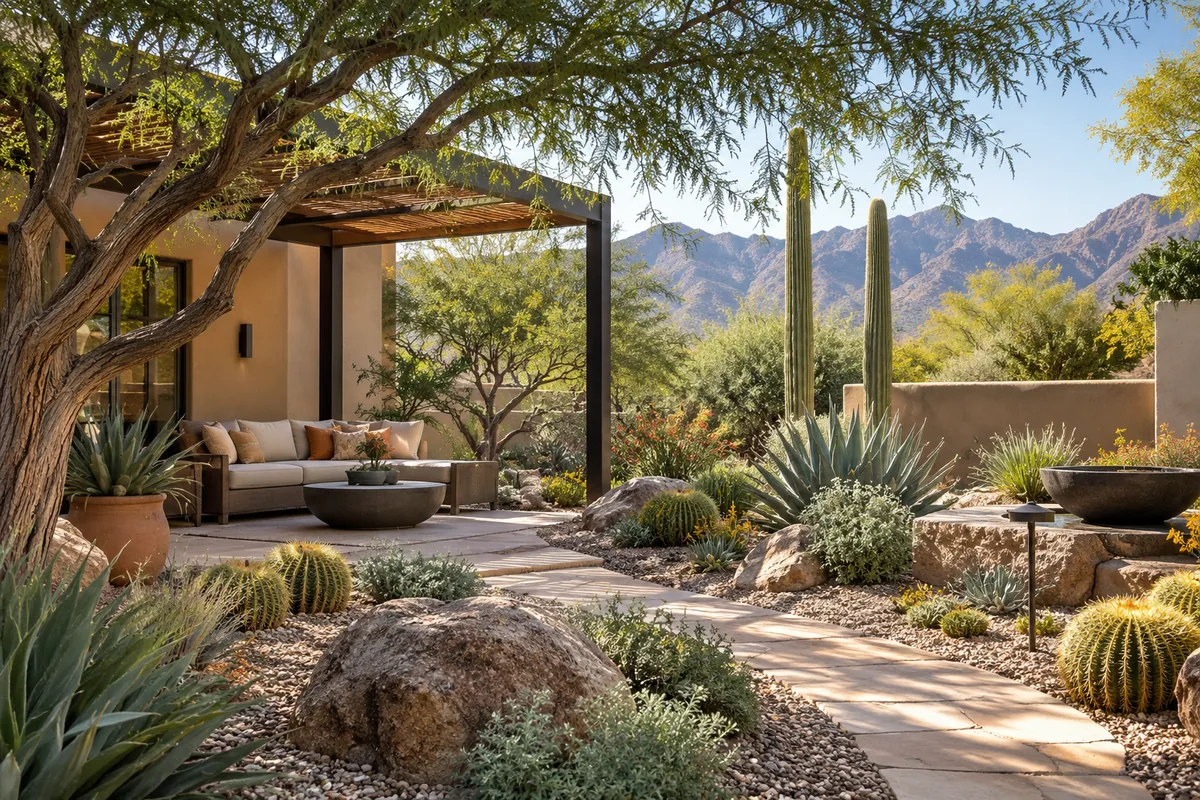
Choose desert landscaping when you want a visual language of arid terrain; choose xeriscaping when reducing landscape water demand is the governing goal. The two can overlap, but they are not interchangeable. Xeriscaping applies water-conscious planning, planting, irrigation, and maintenance to a site; it does not require a gravel yard, cactus collection, or imitation desert scenery.
Last updated · 6 min read
Key takeaways
- Definition: Visual language of arid terrain; Water-conscious design approach.
- Appearance: Open ground and strong forms; Can support several styles.
- Plants: Chosen for arid visual character; Grouped by verified needs.
| Dimension | Desert landscaping | Xeriscaping |
|---|---|---|
| Definition | Visual language of arid terrain | Water-conscious design approach |
| Appearance | Open ground and strong forms | Can support several styles |
| Plants | Chosen for arid visual character | Grouped by verified needs |
| Irrigation | Not resolved by appearance | Part of the planning process |
| Maintenance | Aggregate and plant care | Observation and system adjustment |
| Non-desert sites | Adapt the references cautiously | Respond to local water conditions |
Is this a style choice or a water strategy?
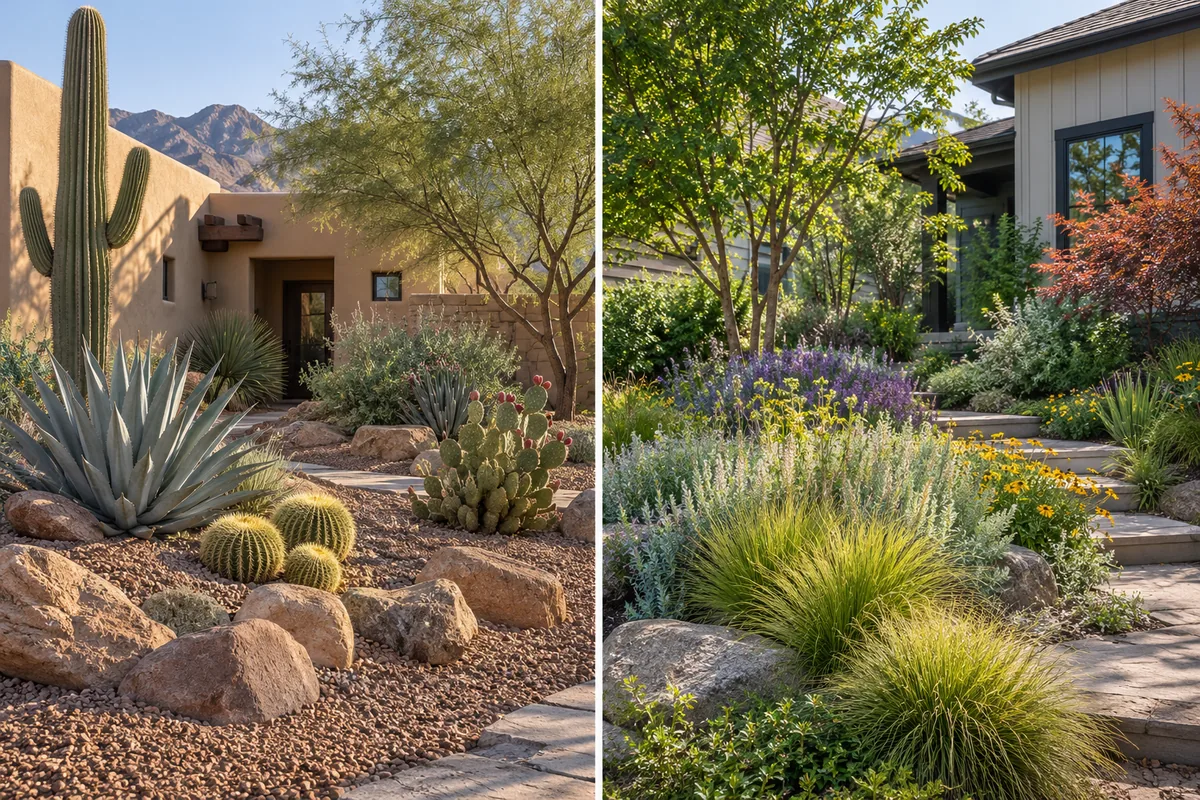
Desert landscaping describes a visual direction that may include open ground, stone, strong plant forms, and a palette associated with dry landscapes. Xeriscaping describes an approach to managing the water needs of a landscape. A desert-looking installation can still waste water through unsuitable plants or leaking equipment. Conversely, a leafy garden can use water-conscious practices without appearing desert-like. According to EPA WaterSense, water-smart landscape design considers plant selection and the way a site is planned and maintained. Use the distinction to separate your appearance brief from the practical water plan. A mood board answers what you want to see; site information is needed to answer what that planting will require.
What changes in a climate outside the desert?
Do not transplant the appearance of a dry region without examining local rainfall, winter conditions, soil, and humidity. A desert reference may show plants or exposed materials that are inappropriate for a wet site. You can retain a restrained arrangement of stone and strong plant silhouettes while selecting locally suitable species. Xeriscaping principles can guide plant grouping and irrigation decisions in other climates, but the actual choices must respond to the place. Check USDA hardiness zone alongside drainage and seasonal moisture; winter temperature alone is insufficient. Ask local horticultural advisers about regional invasive status before purchase rather than using a national style list as a shopping specification.
Does gravel solve water use by itself?
Gravel can provide a visual field or define a path, but covering ground with aggregate does not by itself establish an effective water strategy. Roots still need suitable growing conditions, and rainfall still has to move through or across the site safely. Consider where aggregate could migrate onto a walking route and how plant litter will be removed. Compare it with other surfaces according to intended use instead of treating all uncovered soil as a problem. Existing shade and useful vegetation may be worth keeping. Removing them to produce a desert image can change comfort and maintenance in ways that the picture does not disclose.
How should planting zones be organized?
Group plants according to verified water needs and site conditions, rather than placing every desirable shape under the same irrigation schedule. A dry planting zone beside a covered wall may behave differently from an exposed low area receiving runoff. Mark those differences on the site sketch before choosing the visual palette. Allow for establishment care without assuming that a plant described as drought-tolerant never needs water. Local advice should establish the relevant watering practice. A small, actively used lawn area can be considered separately from ornamental borders; the decision is whether it earns its irrigation and maintenance through real use, not whether a desert style forbids grass.
What should happen to irrigation?
Inspect the system before redesigning the beds. Record which areas receive spray, where water lands on paving, and whether equipment can be reached for inspection. Irrigation should match the planting zones and soil conditions rather than remain unchanged after the landscape is altered. According to EPA WaterSense, outdoor efficiency involves appropriate irrigation as well as landscape choices. Avoid giving a universal watering interval: rainfall, season, soil, and establishment all matter. Have a qualified irrigation professional assess changes where the system is complex. If excavation is needed in the United States, contact 811 before work and ask what private services require separate locating.
Which maintenance costs are easy to overlook?
A desert-inspired yard can still require weeding, debris removal, and attention to plant growth near paths. Gravel around shrubs may complicate collecting fallen leaves, while a dense planting zone may conceal broken emitters. Xeriscaping also requires observation rather than neglect: plants change, weather varies, and irrigation equipment needs checking. Build access into the arrangement so maintenance does not mean stepping through sharp foliage or destabilizing edges. Compare the proposed work with what you already do. The aim is an intentional match between use and resources, not a promise that replacing lawn with rock eliminates every recurring task. Relative costs depend on demolition, soil work, materials, and labor.
Can a planted garden still look desert-inspired?
Yes, if the composition rather than a blanket of stone carries the reference. A limited group of locally appropriate structural plants, an open foreground, and a restrained material palette can suggest dry-land character without copying a species list. Preserve comfortable shade where it supports daily use. Assess thorny plants and loose surfaces particularly carefully near children or pets; consult the ASPCA toxicity list for plants within pets' reach. For grading, retaining walls, and drainage changes, seek licensed local professional advice. The visual style offers no evidence that runoff will be managed safely or that a wall can support the chosen treatment.
How should the final choice be tested?
Write separate appearance and water objectives. For example, the appearance objective might be fewer competing textures, while the water objective concerns unnecessary spray onto a terrace. Compare concepts against both instead of calling every gravel image xeriscape. AILandscape produces visual concepts for exploring a yard's appearance; local review must confirm plants, water management, and construction details. Use a concept to ask where shade and practical routes remain, then work from actual site observations to plan implementation. Keeping a healthy existing feature may serve the water and use objectives better than complete replacement. A successful comparison leaves you with specific next questions rather than a simplistic choice between green plants and bare stone.
Frequently asked questions
Is xeriscaping the same as zero landscaping?
No. Xeriscaping is not a requirement to eliminate planting or cover a yard with rock. It focuses on water-conscious landscape decisions, including plant selection, irrigation, and maintenance. The resulting garden can contain substantial vegetation when it fits local conditions.
Can xeriscaping work in a rainy climate?
Water-conscious planning can be useful outside desert regions. The planting and water-management choices must respond to local rain patterns, soil, and seasonal conditions. Do not copy an arid-region plant palette where drainage, humidity, or winter conditions make it unsuitable.
Are drought-tolerant plants watering-free?
No. Drought tolerance does not establish an identical watering need at every site or remove establishment care. Confirm the needs of the particular plant with local guidance and inspect irrigation accordingly. Avoid treating the label as evidence that a neglected planting will perform well.