
AI Landscape Design 团队撰写 · 编辑方针
Artificial turf vs Natural grass: Which Fits Your Yard?
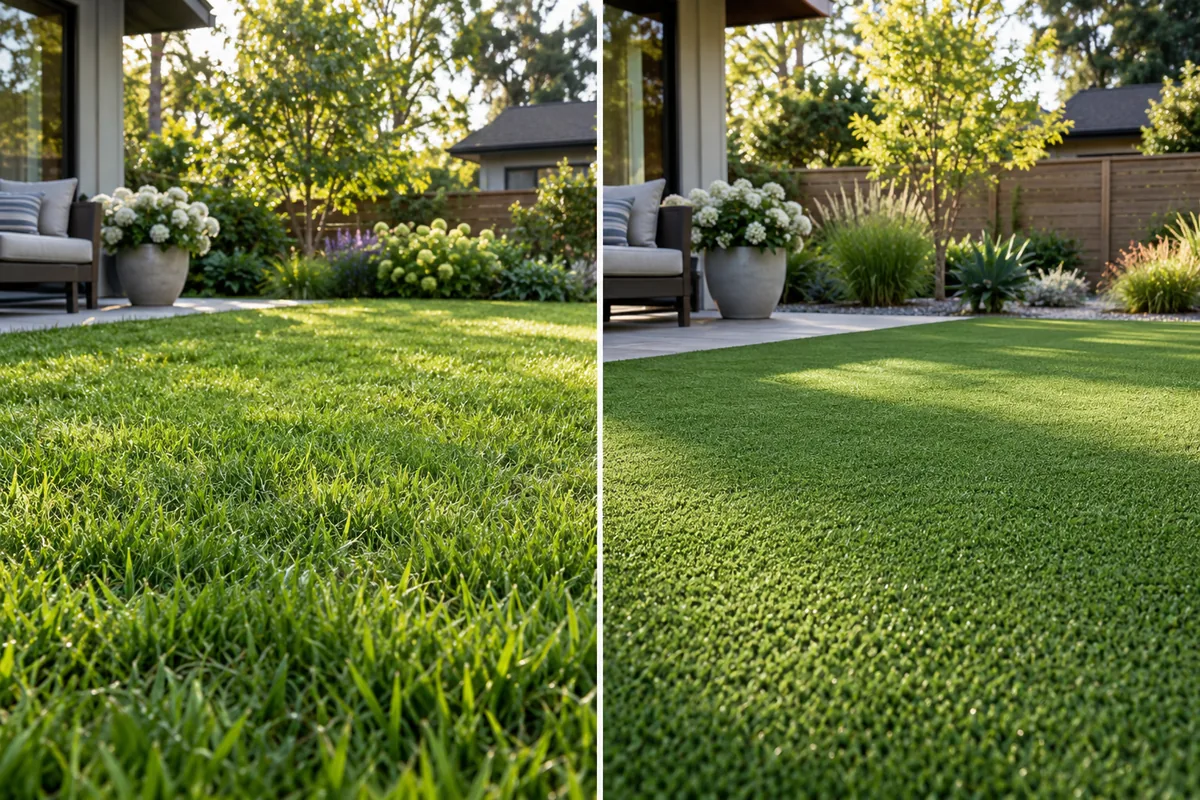
Choose natural grass when a living surface and its growing-season care fit the intended use and local conditions; consider artificial turf only after reviewing heat, cleaning, drainage, product details, and eventual replacement. Artificial turf removes lawn growth rather than every maintenance task. Water use is one dimension of the decision, and a smaller useful lawn or another surface may be a better comparison than full-yard replacement.
发布日期 · 阅读约 6 分钟
要点
- Relative cost: Moderate to Higher; Lower to Moderate.
- Maintenance: Cleaning debris and product-specific care; Mowing and locally appropriate lawn care.
- Lifespan factors: Product wear installation and exposure; Species suitability soil and management.
| Dimension | Artificial turf | Natural grass |
|---|---|---|
| Relative cost | Moderate to Higher | Lower to Moderate |
| Maintenance | Cleaning debris and product-specific care | Mowing and locally appropriate lawn care |
| Lifespan factors | Product wear installation and exposure | Species suitability soil and management |
| DIY difficulty | Higher for full system and drainage | Moderate to Higher with site preparation |
| Best for | Selected uses after heat and cleaning review | Living usable surface with accepted care |
| Water | No growth irrigation but possible cleaning use | Depends on species climate and management |
| End of life | Plan product removal and local disposal | Manage renewal soil and vegetation |
What job must the lawn perform?
Identify the part of the yard actually used for games, sitting, or movement, then separate it from lawn maintained mainly out of habit. Natural grass can provide a living surface where conditions and care support it. Artificial turf can offer a consistently grass-like appearance, but its behavior is governed by the installed product rather than growth. Neither should be spread across the whole property without a use brief. A paved route and planted border may serve some areas more appropriately. Compare the amount of surface needed for real activity, not just whether an uninterrupted green image looks tidy. Reducing unnecessary lawn area can change the decision substantially.
How should watering be compared?
Artificial turf does not need irrigation to grow, while natural lawn care can involve water according to species, climate, establishment, and management. That distinction does not make every artificial-turf installation water-free: cleaning or comfort practices may use water. According to EPA WaterSense, water-smart landscape decisions consider suitable planting and appropriate irrigation rather than treating every landscape the same way. Investigate a locally suitable smaller lawn and an efficient care plan alongside replacement. Avoid invented savings percentages or a universal watering schedule. Ask what the actual household use and local conditions require before selecting a surface on the assumption that its green appearance implies a particular water demand.
What needs investigation about heat?
A manufactured surface and a living lawn can respond differently to sunlight, and the relevant comfort question is the actual site and product. Ask for credible product information and inspect a representative installation under comparable exposure. Do not infer barefoot comfort from a green color or a shaded promotional photograph. Plan how children and pets use the area during sunny periods and consider shade separately. If keeping the surface comfortable relies on repeated wetting, include that practice in the water and maintenance comparison. Avoid unsupported temperature figures. A local assessment and realistic use plan are more useful than a universal claim that every product remains cool or every lawn is comfortable.
How are pet-related tasks different?
For artificial turf, ask how waste is removed, how the selected system is cleaned, and how water moves through its layers. Pet use does not become hygienic automatically because the surface does not grow. Natural grass also needs appropriate waste removal and care, and wear patterns may require attention. Review the cleaning products and methods with the supplier and relevant veterinary guidance where needed. If adjacent planting is changed, consult the ASPCA toxicity list for plants within pets' reach. Consider whether the route to the surface is secure and whether sharp edges or loose infill create concerns. A pet-friendly label cannot replace those site- and product-specific checks.
What does drainage assessment involve?
Both surfaces require investigation of where water goes. An artificial-turf product's permeability claim should be understood within the complete installation, including supporting layers, soil, slope, and overflow. A natural lawn does not correct serious grading or drainage problems simply by growing over them. Licensed local professionals should assess alterations that affect runoff, nearby structures, or retaining elements. Contact 811 before digging in the United States and check private services separately. Do not bury unresolved ground issues beneath a replacement surface. Ask who is responsible for investigating the existing conditions and what happens if the installation encounters problems not visible in the initial photograph.
How should ecological differences be described?
Natural grass is living vegetation, while artificial turf is a manufactured covering; neither statement alone establishes the full environmental performance of a particular yard. Lawn management, local suitability, irrigation, inputs, and the surrounding habitat all matter. Artificial turf involves materials that will eventually need repair or replacement and an identified end-of-life route. Ask what the product contains and what local disposal or recycling facilities actually accept. Do not infer recyclability from a general promotional claim. Consider whether locally suitable planting could occupy unused portions of the area. A comparison that includes a smaller active lawn and more planted ground may address the household's goals better than selecting between two full-property green surfaces.
Which maintenance and costs are commonly missed?
Artificial turf can require debris removal, grooming or product-specific care, cleaning, and correction of damage or displaced components. Natural grass involves mowing and other regionally appropriate growing-season tasks. Compare the actual workload with the available tools, storage, and time. Installation costs for artificial turf may include removal, preparation, drainage work, edges, and access; natural grass costs also depend on preparation and establishment. Broad relative categories cannot predict the quote. Ask what replacement would entail and which materials would be removed. Choose a realistic care routine rather than assuming that avoiding mowing eliminates the household's relationship with the surface.
How can visual concepts support the decision?
Use concepts to compare the amount and position of usable green surface, keeping paths, shade, and furniture consistent. AILandscape provides visual yard exploration; its images do not verify surface temperature, hygiene, drainage, species suitability, or installation details. Review the concept with an actual activity list and local professional advice. If the green surface looks attractive but is rarely used, reconsider whether the area needs turf at all. If play is central, prioritize the product or living surface that can support that use under the site's conditions. The final choice should explain care, water, heat, and eventual repair, rather than judging the two options from a permanently perfect-looking image.
常见问题
Does artificial turf require no water?
It does not need water for plant growth, but cleaning or other care can use water depending on the product and use. Include those practices in the comparison. Avoid treating removal of lawn irrigation as evidence that every installed system is entirely water-free.
Is artificial turf automatically suitable for pets?
No. Review waste removal, cleaning, drainage, heat, and product details for the actual installation. Ask about compatible care methods and obtain appropriate veterinary guidance for concerns. The label pet-friendly does not establish that every surface and site will meet the same needs.
Can I keep a smaller natural lawn instead?
Yes, a reduced lawn sized for actual activities is a useful alternative to consider. Confirm locally suitable grass and a realistic care plan, then use other appropriate surfaces or planting where lawn is not needed. The decision need not be full-yard retention or replacement.
参考来源
相关阅读
Lawn Grass Types Chosen Around Climate and Actual Use
Learn how lawn grass types fit your yard, with practical material, placement, upkeep, and safety questions to review before choosing a visual direction.
Ground Cover Plants for Borders and Deliberate Lawn Alternatives
Learn how ground cover plants fit your yard, with practical material, placement, upkeep, and safety questions to review before choosing a visual direction.
Modern backyard ideas organized around the way you live
Explore modern backyard ideas for activity zones, clean material connections, repeated planting, usable furniture layouts, and careful evening lighting.
Native front yard ideas that make seasonal planting intentional
Find native front yard ideas for regional plant groups, legible borders, seasonal texture, visible entrances, and practical care in a publicly viewed garden.
What Is Microclimate in Landscape Design?
Learn what microclimate means in landscape design, with a practical yard example, related terms, and the site decisions to check before making changes.
Drip irrigation vs Sprinkler irrigation: Which Fits Your Yard?
Compare drip irrigation and sprinkler irrigation for your yard. Review layout, materials, upkeep, and practical trade-offs before choosing a direction.